
Team Resilience: How Leadership Teams Build Consistently Strong Performance
Part 2 of a 3-Part Series: Resilient Leaders | Resilient Teams | Future-Ready Teams
Resilience shows up differently at each level of an organization. In my last article, I focused on leader resilience. When it comes to resilient teams, research makes it clear that you need more than a group of individually resilient leaders.
In the kind of environment organizations are operating in, team resilience matters. Our context today is more brittle, more anxious, less linear, and often harder to make sense of than what most leaders were trained to navigate. Team resilience is the collective capacity to handle pressure, adapt and learn from setbacks, and sustain productivity and effectiveness over time by working through challenges together and reducing how often the team needs to be in recovery mode.
At the team level, resilience shows up in what people do together.
Resilience is not fixed; it’s behavioral and can be developed, because it’s a function of habits, routines, and ways of working that can be strengthened over time. That is why a team can be made up of resilient individual leaders and still not function well together under pressure. The issue is not usually effort or capability in isolation; it’s how the team shares resources, makes decisions, stays aligned, and creates the conditions for people to contribute fully across differences.
How low team resilience shows up
On executive teams, low team resilience is often most evident in the work itself.
One place it shows up is in how resources get allocated. Conversations about budget, headcount, and strategic attention can take on a repetitive quality. Leaders advocate for their own area, priorities compete for oxygen, and the team spends more time than it should negotiating who gets what. Over time, that affects which initiatives move forward, which stall, and whether the organization’s most important work actually gets the support it needs.
It also shows up in the amount of energy required to keep work moving. Decisions are reopened, and priorities shift before commitments have had the chance to take hold. Teams one level down spend time reconciling mixed signals, checking whether direction has really changed, and building plans around uncertainty at the top. What should feel like execution starts to feel like compensation.
It also shows up in the handoffs across functions. Work that depends on multiple leaders and teams slows down where ownership is unclear or coordination is weak. Deadlines begin to move, not because people are unwilling or incapable, but because the team hasn’t created enough shared clarity about who’s doing what, in what sequence, and by when.
These patterns have organization-wide consequences.
The portfolio becomes harder to steer.
Cross-functional work takes more effort than it should.
The next level of leaders inherits the executive team’s ambiguity and strain, then passes some version of it into their own teams.
That’s what makes team resilience such an important executive issue: it shapes not only how the senior team performs, but also the conditions under which the rest of the organization is expected to deliver.
Why this matters beyond the executive team
Senior teams shape the climate for the rest of the organization. Research shows that toxic leadership, toxic social norms, and poor work design are the strongest predictors of toxic workplace culture (Sull & Sull, 2022). Leadership teams sit at the center of all three. Through their ways of working, leadership teams signal and dictate what good collaboration looks like, how conflict gets handled, what behavior gets rewarded, and how work gets structured under pressure.
When a leadership team lacks resilience, signs of internal competition, reactivity, or consistency in how it works together appear, and those patterns often materialize in the next level of teams as well. Some direct reports start mirroring the leadership team: competing across boundaries, revisiting decisions, and protecting turf. While some may build workarounds to keep their teams moving despite tension at the top, it’s inconsistent. Either way, fragmentation within the leadership team permeates the next level of the organization, weakening resilience deeper in the organization.
So What Does Resilience Actually Mean for Leaders?
It's worth pushing back on how resilience has been described in recent years.
Resilience is not about can-do attitudes, pushing through, or asking already-stretched leaders to take a break and then try harder. If resilience is being used that way in your organization, it sets an unattainable standard and will backfire.
In the research-based frameworks we work with at Malida Advisors, resilience is about sustainable high performance. It's the capacity to manage the everyday stress of work and remain healthy, to rebound from unexpected setbacks and learn from them, and to proactively prepare for future challenges.
That word “proactively” matters. Resilience is about both recovery and a forward orientation. Research shows that leader proactivity has a direct, measurable effect on team proactivity; that is, proactivity cascades. A leader's ability to anticipate, act ahead of problems, and create forward momentum shapes their own performance and the performance of everyone they lead.
Resilience is also not a fixed trait. It's not something you either have or you don't. It's a set of behaviors and practices that can be developed, measured, and strengthened at the individual, team, and leadership levels.
Three dimensions worth examining
In practice, different teams will have different pressure points, and no single combination tells the whole story. Among the constellation of elements that impact team resilience, three surface repeatedly in the leadership teams I encounter: (1) how well the team uses its resources (Resourceful), (2) how genuinely it’s oriented around shared success (Alignment), and (3) whether leaders create the conditions for people to contribute fully (Leader Inclusiveness). (The first two are from the Resilience at Work® Team model.)
Resourceful
This dimension is about whether a team can make good use of its resources and processes when demands increase, and budgets or staffing levels tighten. In practical terms, it asks whether the team can realign work, leverage team members’ strengths, and improve how work gets done, or whether silos and internal competition take over (McEwen & Boyd, 2018).
When this dimension is weak, certain patterns tend to repeat. The same parts of the business are regularly overloaded, while capacity in other areas is underutilized. Meanwhile, the same resource debates occur on repeat, with leaders focused more on defending their turf than on where the organization most needs capacity or budget. In contrast, resilient teams engage in open dialogue about tradeoffs, adjust workload and ownership as priorities change, and match work more deliberately to the strengths and capacity available.
Alignment
Alignment, in this context, is not about everyone thinking the same way. It’s about whether the team is genuinely pulling in the same direction and experiencing progress as a shared outcome. In the R@W Team model, this includes how clearly the team connects its work to a common purpose, how it lives its stated values, and how often it notices and marks progress, not just gaps (McEwen & Boyd, 2018; Working With Resilience, 2019). Think of it as the difference between a group of leaders who just sit around the same table and a leadership team that’s actually motivated by the same success story and a shared win.
When alignment is weak, goals may be documented on slides, but leadership team members leave the meeting with different interpretations of what success looks like and why it matters. Over time, their attention and energy drift back toward what benefits their own function and metrics. Decisions are often revisited because the team never truly shared a sense of commitment or win in the first place. When alignment is stronger, there is more clarity about the story the team aims to create together, why a goal matters, what it will take from each function, and how they’ll know they are making progress. Resilient teams adjust functional and individual plans in service of a shared story, and decisions stick more consistently, because people are motivated by the same outcome.
Leader inclusiveness
A third factor is tied to how the team is led. In the research, “leader inclusiveness” refers to team leader behaviors that invite contribution, make room for different perspectives, and signal that people’s voices and experience matter (Hundschell et al., 2025; Nembhard & Edmondson, 2006). It includes practices such as asking for input, acknowledging contributions, and making it safe to raise concerns or differing views, particularly in diverse or multinational teams.
Resilience expands in multinational teams when inclusive leader behavior is supported and amplified by the organization’s systems and norms, aligning with inclusion rather than working against it (Hundschell et al., 2025). Put more simply: when leaders actively draw people in, and the broader environment supports diversity, teams are better equipped to keep functioning under pressure.
Building Team Resilience
Like leader resilience, team resilience is not fixed. It can be developed.
Hartwig et al. (2020) describe team resilience as something that can be strengthened through what teams do before, during, and after stressors, not as a static quality a team either has or does not have. Their work also points to six team states that matter for resilience: psychological safety, team efficacy, cohesion, trust, shared mental models, and adaptability. In executive teams, these show up in very practical ways: how candidly people speak, how confident the team feels in its ability to handle what is coming, how much they trust one another, whether they are working from the same understanding of the situation, and how quickly they can adjust together.
This is where the “how” matters. Team resilience is not built through a half-day off-site alone or generic team-building activities. It’s developed through deliberate work on how a specific team operates and delivers on results in its real context. That kind of work benefits from structure, evidence-backed frameworks, and experienced guidance. Accredited, research-informed team coaching brings all three. The stakes are high, and it is worth being thoughtful about who you trust with your most critical teams.
What leadership teams are carrying now
Competing priorities, imperfect information, and resource constraints are part of leadership. The question is whether the same patterns keep repeating in ways that slow the work down and erode confidence in the team’s ability to deliver. What patterns are you allowing to cascade through your organization?
Resilient leadership teams set the agenda rather than allowing it to evolve on its own. They pay attention to the signals about how they are operating together and work deliberately to build the skills and resilience they need to navigate and recover from challenges. More than that, they design systems and workflows that can absorb pressure and reduce the frequency with which they need to be in recovery mode, rather than relying on repeated “bounce backs” from disruption (Laker & Kalyuzhnova, 2025).
This is why team resilience matters. It’s one of the ways leadership teams protect their ability to deliver in a demanding, often nonlinear environment and shape the conditions under which the rest of the organization performs.
The next article in this series will focus on future-ready teams: how leadership teams move from carrying today’s load to being genuinely prepared for what comes next.
How Malida Advisors Supports Team Resilience
At Malida Advisors, we work with leaders, teams, and organizations to build resilience as a deliberate capability, not an afterthought. Our work in this area draws on validated frameworks that provide concrete, measurable insight into how leaders and teams are operating today and what needs to shift.
We work at the leader, team, and organizational levels because sustainable resilience requires all three. You cannot coach leaders into resilience in isolation from the teams they lead and the systems they operate within, and you cannot ask teams to be resilient while structures and expectations pull against them.
If you would like to explore how we can work with you and your organization, reach out at hello@malidaadvisors.com or visit malidaadvisors.com.
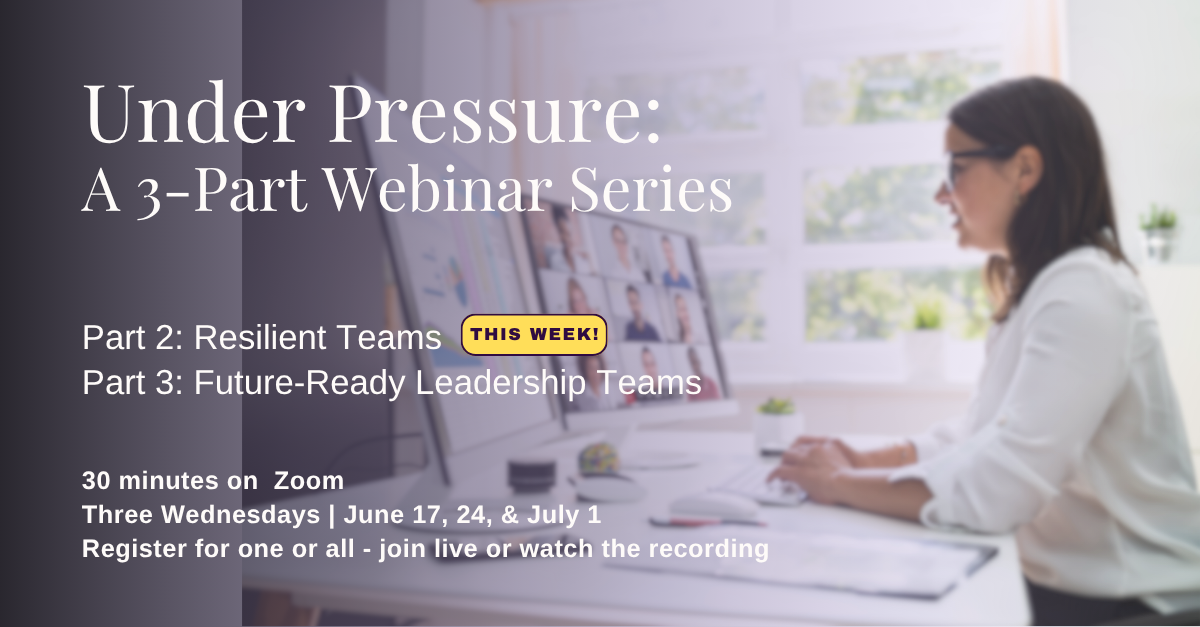
Join us for Parts 2 and 3 of our 3-part series on resilience:
Part 2: Resilient Teams – how leadership teams and their direct reports can absorb disruption together instead of fragmenting
Part 3: Future‑Ready Teams – translating resilience into real adaptability and performance over time
You can learn more and save your spot here: Under Pressure: A 3‑Part Webinar Series.
References
Hartwig, A., Clarke, S., Johnson, S., & Willis, S. (2020). Workplace team resilience: A systematic review and conceptual development. Organizational Psychology Review, 10(3-4), 169-200. https://doi.org/10.1177/2041386620919476
Hundschell, A., Backmann, J., Tian, A. W., & Hoegl, M. (2025). Leader inclusiveness and team resilience capacity in multinational teams: The role of organizational diversity climate. Journal of Organizational Behavior, 46(3), 369–384. https://doi.org/10.1002/job.2829
Laker, B., & Kalyuzhnova, Y. (2025, December 1). Resilience means fewer recoveries, not faster ones. MIT Sloan Management Review. https://sloanreview.mit.edu/article/resilience-means-fewer-recoveries-not-faster-ones/
McEwen, K., & Boyd, C. M. (2018). A measure of team resilience: Developing the resilience at work team scale. Journal of Occupational and Environmental Medicine, 60(3), 258–272.
Nembhard, I. M., & Edmondson, A. C. (2006). Making it safe: The effects of leader inclusiveness and professional status on psychological safety and improvement efforts in health care teams. Journal of Organizational Behaviour, 27, 941–966. https://doi.org/10.1002/job.413
Sull, D., & Sull, C. (2022). How to fix a toxic culture. MIT Sloan Management Review. https://sloanreview.mit.edu/article/how-to-fix-a-toxic-culture/