Davos 2026: The Leadership Agenda for AI
Every January, I carve out time to follow the annual World Economic Forum gathering in Davos closely, and I treat it as one more input into how organizations are thinking about growth, risk, and talent in a volatile world. This year, the conversations clustered around a familiar set of themes: geopolitics and security, macroeconomic uncertainty, energy and defense, and, running through all of it, the rapid acceleration of AI as both an engine of growth and a source of risk. From what I’ve read and watched, three themes for business and AI took center stage at Davos.
1. AI is compelling companies to redesign work for impact, not just bolt tools onto old ways of operating.
That means treating AI as part of org design: being clear about which decisions are human-led, which are AI-assisted, and what quality work looks like in a human–AI world. In practice, that’s work that stretches people’s thinking and creativity, and judgment, not just “more output, faster.” It also means being thoughtful about human development, especially for early-career talent. Consider the impact of offloading all the complexity to AI and removing human experiences that build judgment, resilience, and tolerance for uncertainty; at the same time, this means putting guardrails in place.
(I recommend reaching out to Mat Caldwell and the team at Chiri.)
2. AI is shifting from a productivity play to serving as a growth engine.
Leaders at Davos talked about using AI to drive the top line, reinvesting productivity gains into bolder bets, and applying AI well beyond routine knowledge work into scientific and technical innovation; think pharma and R&D, predictive personalized healthcare, and smarter energy use.
The focus is on outcomes, not just cost: better results for customers and patients, faster innovation cycles, new revenue streams, and substantial impact on society. This means being intentional about using AI to close technology and opportunity gaps by spreading capabilities across regions, functions, and roles, and by pairing speed with strong ethics and governance.
(Get to know Ned Weintraub and the team at NobleAI and Kyna Fong and the team at Elation Health.)
3. AI is fundamentally a people and leadership transformation.
Organizations need leaders who model continuous learning, exercise sharp critical thinking and judgment, and can lead through ambiguity with resilience, trust, transparency, and creativity at the center. Managers must evolve from supervisors of tasks to stewards of human–AI collaboration, including coaching people to work effectively with agents, holding the line on values and psychological safety, and shaping environments where teams can question AI, experiment, and learn.
Leadership itself becomes a scaling mechanism: no single CEO can hold the growing complexity alone. Organizations need a deep bench of well-developed leaders with broad exposure who can absorb shocks, navigate competing pressures, and carry the culture into every AI-enabled decision. This is where deliberate leadership development, succession planning, and talent planning become non‑negotiable strategic capabilities – and where Malida Advisors plays a critical role in helping companies build the leadership depth and maturity this new era demands.
The AI mandate for executives
AI at Davos was about whether leaders can redesign work, channel AI into real growth, and build the leadership bench to handle the complexity that follows. The executive team imperative coming out of Davos is clear: get intentional about how humans and AI will work together, how you’ll invest in leadership depth, and how you’ll protect the conditions for people to keep learning and doing their best thinking.
In February, we’re hosting a virtual executive forum where we’ll dig deeper into what surfaced at Davos and in the latest thinking on AI, innovation, and entrepreneurship – and what it all means for your organization.
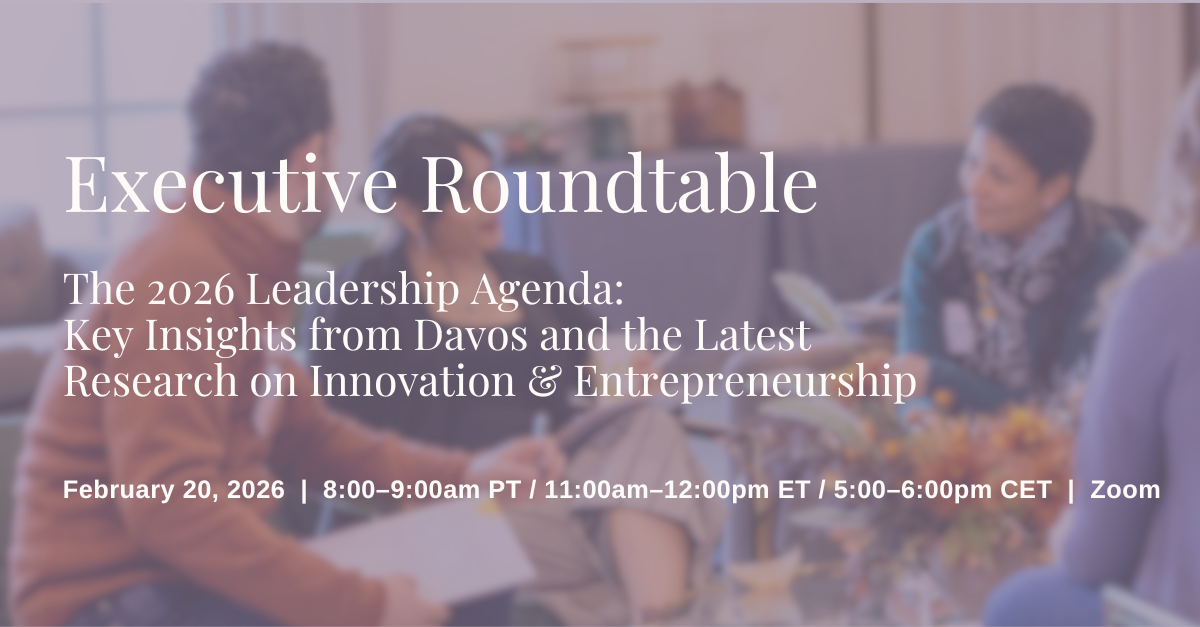
Virtual Executive Roundtable
The 2026 Leadership Agenda: Key Insights from Davos and the Latest Research on Innovation & Entrepreneurship
February 20 | 8:00–9:00am PT / 11:00am–12:00pm ET / 5:00–6:00pm CET | on Zoom
This is an invitation-only, small-group conversation for executives and senior leaders focused on shared learning and real questions. The discussion is off the record and designed as a space to compare notes with peers. If you’d like to be considered for an invitation, reach out here, and we’ll follow up with details.
Natasha Kehimkar is the CEO and founder of Malida Advisors. Natasha and her team help tech and life sciences companies build high-impact leaders and cohesive, future-ready teams. With nearly 30 years of leadership experience at firms like OpenTable, Data.ai, Pfizer, and Guardant Health, she’s known for guiding organizations through rapid change and transformation. Her insights and expertise have been featured in Harvard Business Review, Success Magazine, Forbes, and Business Insider.
Read more